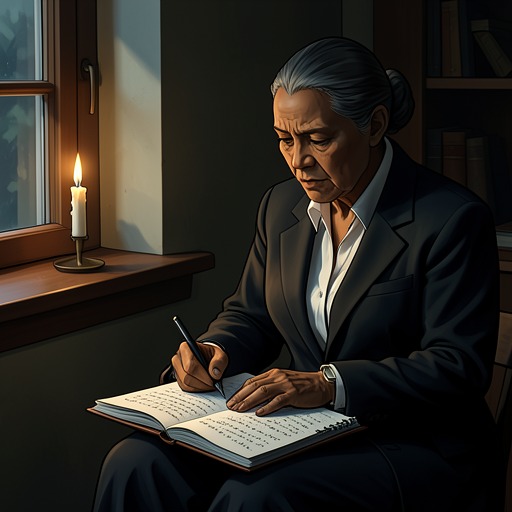
Celie’s spiritual captivity
The Color PurpleCelie’s spiritual captivity names the religious and emotional confinement from which her spiritual life gradually opens. The novel frames her early belief around a distant God and a world in which suffering offers little evidence of divine care; her movement beyond that confinement comes through other people and a reimagining of where the sacred can be found.
Origins and Conditions
The preface identifies Celie’s starting point as spiritual captivity: she begins with a conception of the Divine as distant, while the courage to change and the help of others make a different understanding possible. The book’s opening instruction to tell nobody but God gives prayer a constrained place in her life: God is named as the one permitted recipient of what cannot be told elsewhere. At a later point, when Nettie is preparing to leave, Celie takes comfort in the thought that as long as she can spell God, she still has someone alongside her. That reliance is real, but its loneliness is equally clear: faith serves as companionship when other forms of support seem scarce.
The preface also distinguishes religious captivity from spirituality itself. Its account of the book’s theological journey describes a break from patriarchal images of God toward recognition of the Divine in nature and in human beings. This framing does not make Celie’s suffering a spiritual lesson in itself. Rather, it locates the possibility of freedom in her courage and in the care and insight she receives from others.
Religious Authority and Its Contradictions
The church provides one setting in which Celie’s confinement becomes visible. She works faithfully for the preacher, cleaning the church, making wine, washing the altar linen, and preparing wood for the stove. He praises her constancy, yet his pulpit becomes a platform for denouncing Shug Avery when she is sick and vulnerable. He condemns her singing for money, drinking, and relationships, while Celie recognizes that the sermon is directed at Shug even without her being named.
The scene places service and religious judgment side by side. Celie performs the church’s practical work and is publicly recognized as faithful, but that faithfulness does not prevent the institution’s authority from being used to shame another woman. The episode helps expose a gap between religious respectability and compassionate spiritual attention: the sermon condemns Shug instead of meeting her vulnerability with care.
From Writing to God to Writing to Nettie
A decisive change in Celie’s spiritual life appears in her correspondence. She tells Nettie that she no longer writes to God and writes to her instead. The change does not simply replace one recipient with another. It makes a human relationship the immediate destination for Celie’s words, turning writing into a means of connection rather than leaving her to address a distant presence alone.
The question of what has happened to God follows, and Shug Avery offers Celie a different way to think about divinity. Shug describes God as within Celie and within everybody else, something people may discover by searching inward, or encounter through trouble and sorrow. When Celie asks whether God is an it, Shug rejects a gendered understanding: God is neither male nor female. Her teaching directly challenges the image of a white male God that has made belief difficult for her.
Nature, Attention, and Spiritual Release
Shug’s account also connects the Divine to attention and delight. She explains that God loves what people love, and that noticing beauty matters. The purple flower in a field becomes an example: passing it without noticing is a failure of attention, while the world’s continual creation of something else suggests that delight is not only human but also given back to people.
This natural imagery completes the contrast that defines Celie’s spiritual captivity. A God imagined as distant and patriarchal gives way to a sacred presence understood as inward, shared, and perceptible in the world around her. The preface describes this movement as a release from spiritual captivity into the recognition that Celie, like nature, is an expression of the Divine. Her changed practice of writing, Shug’s interpretation, and the insistence on noticing the purple in a field mark the beginnings of that release without reducing it to a single conversion or a simple rejection of faith.